ICT Professionalism: Progress and Future

Stephen Ibaraki, Founder and Chair, IFIP IP3 Global Industry Council

Gotlieb and Borodin raised the question of Professionalism in computing, as it would develop over time. It is rapidly developing now.

ICT Specialist demand will drop by 60% in the next 3 years. By 2014, 60% of IT Roles will be business facing; over 50% will have business and non-IT Experience.

By 2016, 80% of leading-edge firms will be developing those with multiple skills/with a focus on Professionalism and Business. Business Analysts are already in high demand. There are 35M computing workers growing 30% yearly for the next five years. There is an added 50% in IT that are not even accounted for.


The first major national survey of IT professionals on industry certification finds that 78% are in favor of a complete package or framework for industry certification which includes recognition of vendor certifications, and that combines business and technical competencies where work experience is valued.

In terms of career development, this graphic illustrates what is in demand and my views on what this means:


Career Growth in the future is about having what I call BAIT attributes:

  • Business skills and core industry knowledge where the IT worker is employed;
  • A service oriented Attitude which is a focus on the client and user experience;
  • Deep Interpersonal skills tied in with project management, client relationship management, and communication capabilities;
  • All of this rounded out by Technical skills/competencies with a focus on “professionalism” and current E-Skills.

Demonstrated Progress in Professionalism

The question can be asked: What progress has been made since the publication of Kelly Gotlieb and Allan Borodin’s seminal book, Social Issues in Computing?

The answer is that progress has been profound, far reaching and international.

IFIP, the International Federation for Information Processing was founded under the auspices of the United Nations Educational Scientific Organization in 1960, and now has over 40 country member bodies and affiliates representing over 90 countries. IFIP is a consultative body for IT for the United Nations Educational Scientific Cultural Organization, Sector Member for the International Telecommunication Union, and Scientific Associate Member of the International Council for Science or ICSU.

In 2007, the IFIP General Assembly voted and overwhelming approved their commitment and support for Professionalism and formed the International Professional Practice Partnership (IP3) Board, the international accreditation body for ICT Professionalism and for standards in ICT E-Skills. IFIP IP3 in turn is aligned with the Seoul Accord, the international body for accreditation alignment and standards in post-secondary computing education programs.

CIPS is the official Canadian representative to IFIP and has supported ICT professionalism with professional certifications since 1989. CIPS is also a founding member of IFIP, IP3, FEAPO, ICCP, ICTC, GITCA and the Seoul Accord. All of these bodies support ICT professionalism. In 2012, CIPS Chair Brenda Byers did a national Webcast on Professionalism which received a spotlight from the media and pickup by Ron Richard.

It should be noted that Kelly Gotlieb is the co-founder of CIPS and was at the founding of IFIP. Kelly was also an early pioneer with the ACM and co-author of the first ICT study on ICT-enabled economic development for the United Nations. In 2011, there was a special celebration for Kelly at the University of Toronto, highlighting his significant contributions to professionalism, education, research, government policy and much more.

In 2012, international Professionalism support was in strong evidence for the first time. For example, at the 2012 IFIP World Computer Congress in Amsterdam, an entire stream was dedicated to Professionalism and E-Skills. At the ISACA World Congress in San Francisco, over 80% of their membership is professionally certified. ISACA, with over 100,000 members is the world’s largest and premier association in security, governance and auditing well known for COBIT 5. At the ITU World Summit for the Information Society in Geneva, there was a strong call for action to support professionalism. The Astana World Economic Forum/Connect 2012 (AEF) generated interest in professionalism. AEF recommendations feed into the G8, G20, WTO, World Bank, and OECD.

Security and Cybersecurity continue to top technology needs. In fact, in the US, it is government mandated into curriculum and professional certifications.

In a 2012 interview, Dr. Hamadoun Toure, Secretary General of the ITU provided support for ICT Professionalism. “First, professional best practice is to be encouraged in every industry…In addition, we have our own Ethics office which promulgates its guidelines on professional ethics through regular in-house workshops as well as serving as a focal point for individual staff wishing to consult on issues of professional ethics.”  The ITU is the specialized United Nations Agency governing, regulating and setting global standards in ICT with 193 countries and 700 global corporations/organizations as members.

An update on EU Professionalism which also applies to the North American context was reported by CEPIS Honorary Secretary Declan Brady to the IFIP General Assembly (GA) in September 2012. Declan reported that a comprehensive study into Professional e-Competence in Europe has been undertaken. The study was a ground-breaking research project involving 2000 professionals across 28 European countries. The aims of the project were:

  • To provide a picture of the competences of ICT practitioners in Europe today;
  • To promote and raise awareness of the European e-Competence Framework by using it as the basis for analysis, demonstrating its practical application;
  • To work towards developing a pan-European vision of professionalism.

In addition, the project sought to:

  • Promote IT Professionalism in Europe and assist in developing a pan-European vision of professionalism;
  • Provide an individual profile report to each participant showing gap analysis against e-CF competences;
  • Provide a country report that enables each county to be benchmarked against the European results;
  • provide a pan-European report.

The survey was conduct via on-line tools, using information taken from the e-CF. The research undertaken by CEPIS produced National Reports for 10 countries and a Pan-European Report. These research outputs demonstrate the utility of the e-CF as a practical competence framework as stated in the feedback received from the respondents.

Some highlights of some of the more interesting items from the report follow:

  • Only 21% of professionals had the e-competences to match their declared profile. In other words, 79% may not have the breadth of e-competences needed for their roles;
  • IT Manager was the most declared job profile, however only 8% of these match the e-competences needed for the role;
  • IT professionals across Europe show a low level of competence in some of the five e-CF e-competence areas, especially in ‘Enable’;

The final report produced the following recommendations:

  • The young talent that Europe needs is lacking. Therefore, promoting the IT profession among young people is essential;
  • Continuous Professional Development (CPD) needs to play a greater role and should be targeted to existing and anticipated e-competence gaps;
  • Career paths with defined training and education requirements are needed;
  • All countries urgently need to address the gender imbalance;
  • The e-CF should be applied as a pan-European reference tool to categorise competences and identify competence gaps. It has become clear that the e-CF is a practical reference tool and it should be further disseminated across Europe.

This project has been enormously well received by both the European Commission, and by all the member societies participating. CEPIS is now looking at how to take this further forward, and create an indispensable resource for all stakeholders interested in the shape of professional e-competences across Europe. The full European and national reports can be found at http://cepis.org/professionalecompetence.

The second initiative, a European funded study into “A European Framework for ICT Professionalism” was heading into its final phase at last IFIP GA (General Assembly) in Prague. This project, conducted in partnership with the Innovation Value Institute (www.ivi.ie), has now published its final report to considerable acclaim in the European Commission. This project has re-positioned the European Commission’s thinking on IT Professionalism in relation to its strategy on addressing the future of the IT Industry in Europe.

Some findings from this project include:

  • Little awareness of ICT Competence frameworks and low adoption rates;
  • E-Competence frameworks are unbalanced and often neglect non-technical skills;
  • Two leading benefits identified from ICT Competency frameworks: Process consistency and Workforce capability planning;

The final report and other details about this important research project can be found at http://www.cepis.org/index.jsp?p=827&n=940#CEPISIVI.

A further initiative, based on recommended next steps from the European Framework for ICT Professionalism report, has been to create a repository of Codes of Conduct, Practice and Ethics, as part of the CEPIS Professionalism Taskforce’s work in looking at the importance of ethics in ICT Professionalism. This repository can be found at: http://cepis.org/index.jsp?p=940&n=2849.

Licensing (registration and regulation), though controversial, has also made progress. Software Engineering licensing has focused on areas involving the protection of public health, safety and welfare. Initiatives appear in Alberta, BC, Ontario, Quebec, Texas, Alabama, Delaware, Florida, Michigan, Missouri, New Mexico, New York, North Carolina, Virginia, etc., and internationally (Australia, UK, New Zealand, and others). In the US, the Principles and Practices (PE) exam has been launched in 2013.  To be licensed requires graduation from an engineering accredited program, passing a fundamentals of engineering exam, four or more years of professional practice, and passing the PE exam. Malaysia is undertaking a more extensive ICT-wide program with support from international communities such as IFIP and the Seoul Accord.

The Prime Minister of Canada has acknowledged that CIPS’ work in certification, accreditation and professional development have made positive and lasting contributions to Canada’s economic growth and competitiveness.

In 2011, IFIP hosted the first World CIO Forum (WCF) with involvement of over 800 senior executives from industry, government and academia. In their WCF “Joint Declaration” they stated, “We strive to support [the] IT Industry and professionalism of IT career.” “We will ensure the highest standards in our work, and with both quality and ethics, and will act diligently and professionally, and with integrity in discharge of our duties for the best interest of our respective organizations and society.”

Tadao Saito, CTO of Toyota, a global fortune 8 company with over $220B USD in revenues, stated “[IFIP] IP3 [International Professional Practice Partnership] is the start of this kind of important global activity.” This is a key acknowledgement of the importance of ethics and IT professionalism which lays the foundation for IT as a recognized profession.

There is also support for Professionalism from  the Global Industry Council consisting of prominent leaders from business, industry, governments, academia, international bodies representing over 15 Trillion USD in market capitalization and GDP. The “Global Industry Council Directors are specially nominated and invited to serve within the UN-rooted body as internationally recognized luminary executives, thought leaders and visionaries and for their strong history of providing substantive contributions to global business, industry, society, education, and governments. The IP3-GIC is a first of its kind focusing on Computing as a Profession, which will further align computing with organizational strategy and business agility driving innovation, entrepreneurship, business growth, regional GDP growth, high yield investment opportunities, and regional economic development. Global GDP is over 70 Trillion USD and the global program for computing as spearheaded by IP3 and IP3-GIC will be a catalyst for a more than a 20% increase in global GDP in the next 10 years to over 85 Trillion USD.”

In a meeting I had with senior Canadian government officials in 2006, they commented about 3rd party support for Professionalism outside of established professional bodies such as the IEEE-CS, BCS, ACS, and CIPS. In 2013, a good example of this support would be GITCA (Global IT Community Association). GITCA is the world’s largest federation of over 1200 professional groups and associations representing over 6 million executives, IT professionals, and students. GITCA supports IFIP IP3 professional certification and professionalism. They believe that IFIP IP3’s accreditation program of ethical conduct, demonstrated professional development and recognized professional certification are the hallmarks for an enabled IT professional and profession.

Conclusion

Kelly Gotlieb and Allan Borodin’s seminal book, Social Issues in Computing, laid the foundation for the continuing evolution of ICT professionalism with the key elements of accredited education, demonstrated professional development, adherence to a published code of ethics, alignment with best practices and an ICT Body of Knowledge (BOK), and recognized credentials though not necessarily licensing. Licensing was deemed too restrictive since there was and is a global shortage in ICT skills.

ICT is integrated into all facets of business, industry, governments, media, society and consumers. This is demonstrated in the latest ICT trends and the business-focus of ICT Skills, all of which demands professionalism.

Since the publication of the book, considerable strides have been made in support of Professionalism with endorsement of the UN-founded IFIP, and many major international organizations. In addition, professional certifications are already mandated in ICT-related domains such as project management, security/cybersecurity, governance/auditing; addressing closing the Skill gap and demands for STEM education and innovation. There is also a tie-in to increasing economic health and growing GDP.

Beyond the publication of the book, Kelly Gotlieb continues to be a driving force for positive change in the world enabled by ICT and professionalism cemented on his pioneering role with IFIP, CIPS, United Nations, ACM, government policy, academic contributions and societal impact.

Kelly and Allan foresaw many major issues in computing and many of these issues will no doubt continue to be priorities at the 100th anniversary of the book’s publication, clearly establishing its value in history.

Stephen Ibaraki is the founding chairman of the United-Nations-founded IFIP-IP3 Global Industry Council, as well as iGEN Knowledge Solutions, Global Board GITCA, and first board chairman, The Vine Group. He serves as vice-Chair of  the World CIO Forum, founding board director FEAPO, and is a past president of the Canadian Information Processing Society(CIPS), which elected him a Founding Fellow in 2005.  Ibaraki is chair of the ACM Practitioners Board Professionalism and Certification  and Professional Development Committees, and is the recipient of many ICT awards,  including a IT Leadership Lifetime Achievement Award, an Advanced Technology Lifetime Achievement Award,  Professionalism Career Achievement Awards, an IT Hero Award, the Gary Hadford Award, and others.  Ibaraki has been the recipient of a Microsoft Most Valuable Professional Award each year since 2006. Ibaraki serves as an advisor on ICT matters for a variety of global organizations, companies, and governments.


Digitizing Ozymandias

Barry Wellman, S.D.Clark Professor of Sociology and Information, University of Toronto

For 40 years, computer scientists and sociologists have mostly danced
unaware of each other. Kelly and Alan’s book was a pioneering conversation
starter for computer scientists taking into account the social forces
driving computing and the social implications of what computerization has
wrought. Both authors have wonderfully kept the conversation going, and
they have been joined by sociologists studying the impacts of technology
on the structure of society and our everyday lives.

Digitizing Ozymandias

The dialectic between the virtual and the material is not new. Recall Percy Bysshe Shelley’s 1819 poem Ozymandias describing the statue of a fictional great warrior, where only the legs and the pedestal remain. Here’s the poem:

I met a traveller from an antique land
Who said: Two vast and trunkless legs of stone
Stand in the desert. Near them, on the sand,
Half sunk, a shattered visage lies, whose frown,
And wrinkled lip, and sneer of cold command,
Tell that its sculptor well those passions read
Which yet survive, stamped on these lifeless things,

The hand that mocked them and the heart that fed:
And on the pedestal these words appear:
“My name is Ozymandias, king of kings:
Look on my works, ye Mighty, and despair!”
Nothing beside remains. Round the decay
Of that colossal wreck, boundless and bare
The lone and level sands stretch far away.

And of course, someone has constructed a physical replica of the non-existent statue that has been virtually portrayed in the poem.

wellman-f1
Figure 1: Ford Madox Brown, 1870. Romeo and Juliet, oil on canvas. Delaware Art Museum, Wilmington, Delaware. 1

Nor is Ozymandias a singular case. The next time you go to Verona, I guarantee you’ll see a crowd gathered at the base of “Juliet’s balcony”. Indeed, you can rent the balcony for your wedding ceremony.  But, of course, Juliet (and Romeo) existed only in the world of Shakespeare’s 16th century play. If they had lived today, they would have used mobile phones to stay alive. Their reliance on mobile phones would have removed them from the surveillance of their parents. “But their parents would have seen the bill at the end of the month,” one of my students protested. “Not if they texted,” another student from the Middle East answered knowingly.

So the interplay between the digital and the material – between atoms and bits – continues and develops. Yet, these are not separate worlds: there is no “digital dualism”, to use Nathan Jurgenson’s nice term (2012). Rather, we and our physical objects are part of the same worlds, although we need to think carefully about how we take care of and link our bodies, minds, and artifacts.

On November 13, 2012, Whitney Erin Boesel tweeted and emailed about a debate in her University of California Santa Cruz graduate course. Sociology professor Jenny Reardon asked her class, “What about albums: Do people still listen to albums.” Boesel reported: “This caused some confusions; what does she mean by ‘album?’ Do digital files count? I interjected to define an album as ‘a set of tracks that an artist records and releases together, as a set and in a specific order, that you listen to in that order.’” Prof. Reardon responded, “See, an album is no longer a ‘thing’; it’s become a concept!” The material album has become a virtual concept.

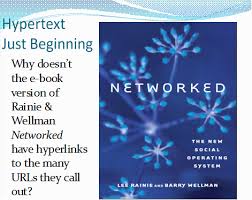
Hypertext Just Beginning: Why doesn't the e-book version of Rainie & Wellman Networked have hyperlinks to the many URLs they call out?Yet, I am writing this essay while listening to the sound of the Rolling Stones’ greatest hits—on a vinyl LP of course. Next to me, the face of Keith Richards stares from the material cover of his majestic autobiography (2010), part of whose joy is its hefty 565 pages. This is an experience that cannot be fully reproduced in an e-book.

But even an e-book is crippled today. When I read Keith Richards on e-book, I should be able to click and hear the song he’s discussing, and I should be able to click on the photos or videos of the events he is recounting. I can’t get enough satisfaction just reading the text, despite a pretty good rock n roll memory. When Lee Rainie and I put together our Networked book (2012), we were frustrated that the Kindle e-book version did not have any hyperlinks. When Toronto subway riders read the electronic version of the porn novel Fifty Shades of Grey  (James, 2011), where are the animations, the moans, and the instructional videos? This might be one of the few places where earphones would be welcomed by all.

Mona Lisa
Figure 2: Leonardo da Vinci, 1503-1505. Mona Lisa, oil on poplar wood. Musée du Louvre, Paris.1

Look at how formerly stand-alone objects have gone digital and social. Consider the Mona Lisa, at whom multitudes have stared while trying to figure out who she was and why she is half smiling. Even Nat King Cole could not figure it out (http://www.youtube.com/watch?v=EG-A_qTAKEI).

Of course, the social came before the digital. Leonardo didn’t just do solo shots: consider his The Last Supper. It may be two-dimensional, but it certainly shows some of the connections among Jesus and his disciples.

Nor is the digital always social. Some of us are old enough to remember that the first personal computers in the 1980s predated the internet. They were primarily stand-alone word processors and spread sheeters. But then social media came along, now epitomized by Facebook. Basically, it combines the Mona Lisa with the Last Supper. One heart of Facebook is the self-portraits it presents: the profiles that individuals prepare about themselves. This is the Mona Lisa and the Ozymandias approach. Or, if you prefer a digital approach, it resembles the one-way nature of Web 1.0 where many of us prepared self-description pages complete with bloggish musings. Imagine if Jesus had his own page, with all of his sayings on it. Or if you are secular, call up “facebook” on Google images, and the first screen will be filled with multiple pictures of Facebook founder Mark Zuckerberg. If you believe The Social Network movie, Zuckerberg founded Facebook to find friends (Fincher, 2010).

The Last Supper
Figure 3: Leonardo da Vinci, 1495-1498. The Last Supper, pitch and mastic. Convent of Santa Maria della Grazie, Milan.1

But, Facebook is more than profiles. It is also a series of fishing lines, connecting the person at the centre of the network to his or her “friends”. In short, it’s the fellowship of the Last Supper, with each person at the centre of his or her universe. Yet Facebook can do better than Leonardo in two ways. First, it can provide detailed profiles of each individual, and second, it can provide openings to learn about friends of friends. Just who was Judas hanging out with? Oxford sociologist Bernie Hogan and I are writing a paper about this called “The Relational Self-Portrait: How Social Network Sites Put the Network in Networked Individualism” (2013).

Moreover, just as Facebook connects individuals to their friends, the concatenation of these networks connects cities and continents. Although this is a relational artifact that only digital analysis can discover, nevertheless, it is real. At times, the digital and the physical coincidence: Yuri Takhteyev, Anatoliy Gruzd, and I (2012) have shown that interconnections on Twitter largely mirror airline routes. Many people use Twitter to talk to those with whom they have in-person contact.

In our NetLab’s work, we argue that North Americans—and perhaps others—are moving toward a networked society centred on individual connectivity—what Lee Rainie and I have called “networked individualism” (2012). What are the implications for the missions of libraries and archives?

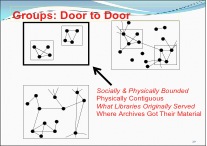
Groups: Door to DoorIn pre-industrial days—and still in very rural parts of Canada—the society was door-to-door. The building block was groups, embedded in villages and neighbourhoods, with all of their social support and social control. This is where people got their information. This is what libraries originally served and where nascent archives—often in the hands of village schoolteachers, clerks or pastors—got their material. Indeed, some of us still wander churchyards to get our historical sense of a place. Big national libraries and archives were far away, difficult to access, and only for canonically important material. Mostly, knowledge came from within the group and stayed within the group.

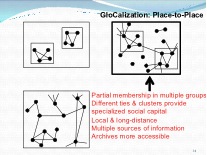
GloCalization: Place-to-PlaceThe situation changed in the late twentieth century with the proliferation of multiple technologies that weakened the boundaries of distance: the telephone, the car, the airplane for two-way communication, and the radio, movies, and television for one-way information flows. In this “glocalized” milieu, family and work units remained important, but information and communication links were less constrained by distance—what we call “place-to-place” connectivity (Wellman and Hampton 1999).

Rather than a single canonical source of information and communication, people were embedded in multiple, partial social networks that sometimes conflicted. Information sources proliferated, and while archives remained distant, they became more accessible. Although I write in the past tense, this situation continues for many people.

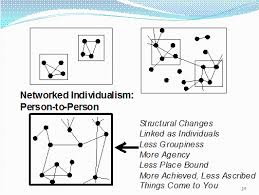
Networked Individualism: Person-to-PersonPersonal networks have come to the forefront with the proliferation of personal computers, the internet, mobile devices, and multiple-car households. People function more as networked individuals and less as group members. This provides them with greater access to multiple sources of information and communication, at the cost of less contact with tangible objects. I call up a picture of Ozymandias or The Last Supper rather than having a direct physical encounter with them. Rather than LP records or CDs, there are personal MP3 players. Information has become networked through links, crowdsourcing, perpetual editing, and feedback. The social control of the group has been replaced by the social control of governments and large organizations that have access to emails and databases of search information. For better or worse (and in fact, both simultaneously), amateur experts sit aside credentialed experts. Books, music and objects—the historic domain of libraries and archives—are now going to people rather than people going to them.

The map we now have of how people will communicate and get informed is undoubtedly wrong. We know little about the bulk of online communication that resides in the dark web that Google and Facebook do not access; we know even less about what the future will bring. We do know there will be ongoing tensions between personal freedom and mega-organizational control (Kling, 1989; McElheran 2012; Rainie and Wellman, 2012; Chapter 11). Who will the agent-based software work for? We do know the half-century long struggle between digital personalization and central control will continue as we all grope toward a better future.

References

Fincher, David, director. 2010. The Social Network. Culver City, CA: Columbia Pictures. October 10.

Hogan, Bernie & Barry Wellman. 2013. “The Relational Self-Portrait: How Social Network Sites Put the Network in Networked Individualism.” Forthcoming in Society and the Internet, edited by Mark Graham and William Dutton. Oxford: Oxford University Press.

James, E(rika). L(eonard). 2011. Fifty Shades of Grey. New York: Vintage.

Jurgenson, Nathan. 2012. “The IRL Fetish.” The New Inquiry, June 28. http://thenewinquiry.com/essays/the-irl-fetish/

Kling, Rob. 1989. “The Institutional Character of Computerized Information Systems.” Office: Technology and People 5(1): 7-28.

McElheran, Kristina. 2012. “Decentralization versus Centralization in IT Governance.” Communications of the ACM 56, 11: 28-30.

Rainie, Lee and Barry Wellman. 2012. Networked: The New Social Operating System. Cambridge, MA: MIT Press. Kindle e-book: http://www.amazon.com/Networked-ebook/dp/B007Z6GW0Y/ref=tmm_kin_title_0?ie=UTF8&qid=1325258020&sr=1-1

Richards, Keith. 2010. Life. New York: Little Brown

Shakespeare, William. c1597. Romeo and Juliet.

Shelley, Percy Bysshe 1819. “Ozymandias” in Rosalind and Helen, a Modern Eclogue, with Other Poems. London: Ollier.

Takhteyev, Yuri, Anatoliy Gruzd and Barry Wellman, 2012. “Geography of Twitter Networks.” Social Networks: 34, 1: 73–81

Wellman, Barry and Keith Hampton. 1999. “Living Networked On and Offline.” Contemporary Sociology 28, 6: 648-54

1 All photographic reproductions of works of art are taken from Wikipedia. These photographs, as well as the original masterpieces, are held in the public domain.

Acknowledgements

I am grateful for the comments of the participants in the Library and Archives Canada “Whole-of-Society” seminar (Ottawa, November 2012) and for the editorial support of Christian Beermann, Isabella Chiu and Esther Jung Yun Sok.


Barry Wellman is Director of Netlab and the S.D. Clark Professor of Sociology and Information at the University of Toronto. He recently published the prize-winning book, “Networked: The New Social Operating System”, co-authored with Lee Rainie for MIT Press (2012).  A member of the Royal Society of Canada, Wellman is Chair-Emeritus of both the Community and Information Technologies section and the Community and Urban Sociology section of the American Sociological Association. He founded the International Network for Social Network Analysis, and co-edited “Social Structures: A Network Approach” which has been named by the International Sociological Association as one of the “Books of the Century”.  He has been affiliated with Intel Corporation’s People and Practices research unit and is a Fellow of IBM Toronto’s Centre for Advanced Studies. Wellman has been a Fellow of IBM’s Institute of Knowledge Management, a consultant with Mitel Networks, a member of Advanced Micro Devices’ Global Consumer Advisory Board, and a keynoter at conferences ranging from Computer Science to Theology. He has authored or co-authored about 300 articles with more than eighty scholars, and he is the (co-)editor of three books.

Computers in Developing Countries: An Update

Kenneth L. Kraemer, Research Professor, The Paul Merage School of Business, University of California, Irvine

Looking Back

2013 marks 40 years since the publication of Social Issues in Computing (Academic Press, 1973) by Calvin Gotlieb and Allan Borodin.  Their central concern in the section on  “computers in developing countries” was “How should computing be applied in developing countries and what might be the impacts of that application?” They cited reports of international agencies (OECD, UNESCO and the United Nations), which argued that some computer activity was appropriate for developing countries and these countries should be actively engaged in seeking how to make use of computers for their situation.  They also noted that although some officials in developed countries felt that developing countries should focus on more urgent, basic needs such as food, health and poverty, officials in developing countries rejected this view because they regarded computers as stepping stones to social and economic development. They showed determination to join the computer revolution by investing in computers, seeking education and participating in computing-related meetings and conferences.

While encouraging computer use, Gotlieb and Borodin urged government officials in developing to be cautious about trying to develop their own computer industry.  They argued that only a very few large developing countries, such as India, would have the technical and human resources required, and so they urged countries to concentrate on computer applications.  With respect to social impacts, they felt that developing countries would experience social issues such as unemployment, privacy threats and the need for skills development similar to the industrially advanced countries.   Their chief concern was that “the gap between the industrially advanced countries and those which are still developing is widening”.

 Looking Forward

This short article will review what we know about the foregoing issues:  (1) the returns to IT investment (2) computer production vs. use and (3) the digital divide.  At the time that Social Issues in Computing was published, I had just become Director of the Public Policy Research Organization (which later morphed into the Center for Research on IT and Organizations or CRITO) at UC Irvine.  We had just received our first NSF grant to study policies for effective use of computers in governments in the U.S.  Rob Kling, Jim Danziger, Bill Dutton, Alana Northrop, John King, Suzanne Iacono and Debora Dunkle were all colleagues in this work and one of our first tasks was to do a literature survey. It was Rob Kling who brought this book to our attention, mostly for its concern with the social and economic impacts of the technology. We were not thinking about developing countries at the time, but turned to them in the nineties at which time we became interested in understanding why so many developed and developing countries were not succeeding in their attempts to develop domestic computer industries. With this context setting, we examine the issues.

Payoffs from IT investment in developing countries

The question of whether IT investments lead to greater productivity and economic growth has been studied extensively at multiple levels of analysis, with strong evidence that the returns to IT investment are positive and significant for firms, industries and developed countries.  Cross-national research for the 1985-1993 time period found that IT investment was associated with significant productivity gains for developed countries but not for developing countries (Dewan and Kraemer, 1980).  Other studies found similar results (Pohjola , 2001).

Nonetheless, developing countries increased their investment in IT from 0.5% of GDP in 2000 to 1.0% from 1994 to 1997.  For some the change has been dramatic.  For example, China had fewer than 10 million PCs in use in 1997 and barely 1 million Internet users.  In 2011, China passed the U.S. as the largest PC market and led the world with over 400 million Internet users (Shih, Kraemer and Dedrick, forthcoming).  Similar rapid growth in places such as India, Latin America, Southeast Asia and Eastern Europe has transformed the landscape for IT use in developing countries.  So, an important question is  whether this level of investment and experience has now changed the results for developing countries.

A recent study, which analyzed new data on IT investment and productivity for 45 countries from 1994-2007, found that upper-middle income developing countries have achieved positive and significant productivity gains from IT investment in this more recent period as they have increased their IT capital stocks and gained experience with the use of IT (Shih, Kraemer and Dedrick, forthcoming). The study also found that the productivity impacts of IT are moderated by country factors including human resources, openness to foreign investment, and the quality and cost of the telecommunications infrastructure. These policies are useful in their own right, but the study suggests that the impacts of IT depend not only on the level of use, but on the presence of resources and favorable policies to support IT use.

The academic implication is that the impact of IT on productivity is expanding from the richest countries into a large group of developing countries.  The policy implication is that lower tier developing countries can also expect productivity gains from IT investments, particularly through policies that support IT use, such as greater openness to foreign investment, increased investment in tertiary education, and reduced telecommunications costs.

IT Production versus use

Gotlieb and Borodin’s 1973 caution that most developing countries should focus on computer use rather than production was wise, and prescient.  Many countries have sought gains from investments in IT production rather than IT use, but the research shows that there are gains to the whole economy from investment in IT use rather than gains to only a single industry sector from investment in IT production.  The significance of investment in IT use is heightened by the fact that production in the IT industry is now global.  Increasingly, products designed in one country are made in others with components from still other countries and then marketed throughout the world.  This global production system relies on IT to link it all together.  Therefore, countries desiring to participate in the global production system must develop IT capabilities through both short term and longer term strategies.  By doing so, countries can not only participate in the global production system but also increase the productivity of their economy, and thereby raise the standard of living for their citizens.

Recognition of this fact has been slow in coming. In the 1950s with the introduction of computers, many countries wanted to develop their own computer hardware industry and many of the advanced industrial countries did so.  The history of the industry shows that success requires large investments in R&D and human resources, and that one misstep in this highly competitive global industry can bring downfall.  Computer makers in England, Germany, France and Italy succeeded initially against the leader IBM because they were national champions, but there were unable to compete on the world market and were bought out, merged or disappeared.  Japanese companies succeeded longer in their protected market.

With the introduction of the PC, new opportunities arose for developing countries. Domestic companies in such as India, Brazil and Mexico succeeded for a while in their own markets, but could not compete globally with the multinational brands or their own white box makers. Because of its large English-speaking population, India switched from computers to software and services whereas Brazil and Mexico companies exited quietly.  Taiwan and China traditionally have been workshops for the multinationals, but China’s Lenovo and Taiwan’s Acer have risen to number two and three in the global computer hardware industry.  Neither China nor Taiwan is a model for other developing countries due to their unique circumstances.  The oft-cited successful small countries like Singapore and Ireland have been regional outposts for multinationals despite the hyperbole about having a domestic industry.

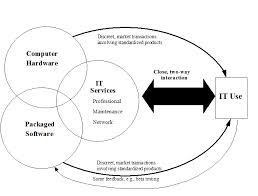
However, there is a side of production that is close-to-use (Figure 1), which has proven valuable for some developing countries even though Gotlieb and Borodin did not specifically identify it at the time– the development of packaged software and information services.  India has succeeded tremendously as an offshore workshop for software development and for computing services around the world. However, the industry has not yet created notable packaged software.   Many smaller developing countries such as Brazil, Costa Rica, Bulgaria, and Israel are also succeeding in software development and information services, usually as a result of language or specialized knowledge/skill.

China set the goal of becoming a computing software and services powerhouse as early as the mid-eighties and in its subsequent five-year plans.  Since 1999, China has made the “fundamentals of computer science” mandatory for all university students and now graduates over a million computer scientists a year (Zang and Lo, 2010). This has not gone unnoticed by foreign multinationals who rushed into China after 2000 to take advantage of the large, low cost labor pool.  However, multinationals (MNCs) that employ graduates report that they have theoretical knowledge but little practical knowledge.  A recent study of five large U.S. MNCs in the computer and telecommunications industry indicated they employed from a low of 4,000 to a high of 20,000 computer professionals in their software and services operations in China (Dedrick et al., 2012).  The study also indicated that the MNCs must put new hires through in-house training programs for up to a year.  The training involves not only teaching in-house methods, but also promoting greater work discipline and teaching teamwork, as China’s one child policy has created many little emperors.  Still, these computer professionals are developing valuable practical skills, learning how Western and other Asian organizations operate and rising up to management and leadership positions within the MNCs.  Whereas foreign MNCs were the first job choice of Chinese computer science graduates early on, government enterprises and the military are now the first choice followed by Chinese private enterprises and then the foreign MNCs.  One only has to read daily newspaper accounts of hacked corporations and government agencies the world over to realize the advanced skill and creativity being achieved by at least some Chinese computer professionals.

As early as the nineties, several experts urged developing countries to follow production close-to-use strategies (Schware, 1992; Dedrick and Kraemer, 1998), but only a few have done so.   Although late in coming, a recent UNCATD (2012) study urges developing countries to develop indigenous software capabilities in order to take advantage of IT opportunities. It makes a strong case for the social and economic benefits to be gained from leveraging software skills in the domestic market – in both the private and public sectors. It urges governments to promote domestic software writing that meets local needs and local capabilities as a means of increasing income and addressing broader economic and social development goals.  The argument is that developing such software locally increases the chances that it will fit the context, culture, and language where it is used.  The Report also argues that such capabilities also can help to expand software exports.

Figure 1.  Information services as link between production and use

Kraemer-Fig1

Source:  Dedrick and Kraemer, 1998


The Digital Divide

Gotlieb and Borodin, like many others since, were concerned that the gap in use of IT between developed and developing countries was widening.  The literature documents this digital divide, or difference in cross-country penetration of computers, the Internet, smart phones and other ITs.  Explanations for the divide usually are based on socio-economic factors such as GDP, human capital, openness to trade, IT infrastructure and IT costs–especially telecommunciations costs. However, a recent cross-country study of the diffusion of personal computers (PCs) and the Internet in 26 developed and developing countries over the period 1991-1995 indicates that the divide might be narrowing due to co-diffusion effects between PCs and the Internet (Dewan et al., 2008).  That is, the adoption of PCs leads to greater adoption of the Internet, which in turn leads to greater adoption of the Internet in a virtuous cycle.  Moreover, the study found that the impact of PCs on Internet diffusion is substantially stronger in developing countries as compared to developed ones.

The fact that these co-diffusive effects are a significant driver of the narrowing of the digital divide has policy implications for developing countries with respect to how diffusion of PC, Internet, and smart phone/tables technologies might be harnessed to further accelerate the narrowing of the global digital divide.  The key is government policies that promote expansion of the IT infrastructure, lower the cost of access devices and telecoms costs and upgrade users’ knowledge and skill.  Even then, it is necessary to recognize that there will be failures along the way, as illustrated by the OLPC effort to bring low cost computers to schools in the poorest countries of the world (see box).

The OLPC experiment

[The abstract below is from an article that appeared in Communications of the ACM called “One Laptop Per Child (OLPC): Vision and Reality” (Kraemer et al., 2009).  It documents the experience with OLPC and suggests reasons for its failure to achieve the original goal of transforming education while unintentionally creating a new segment in the IT industry to compete with its own invention.]

In January 2005, at the World Economic Forum in Davos, Switzerland, Nicholas Negroponte unveiled the idea of One Laptop Per Child (OLPC), a $100 PC that would transform education for the world’s disadvantaged school children by providing the means for them to teach themselves and each other.  Negroponte estimated there could be 100-150 million of these laptops shipped every year by the end of 2007 (BBC News, 2005).  With $20 million in startup investments, sponsorships and partnerships with major industry players, and interest from several developing countries, the non-profit OLPC project generated excitement among international leaders and the world media.  Yet as of January 2009, only a few hundred thousand laptops had been distributed and OLPC had scaled down its ambitions dramatically.

Although some developing countries are deploying the OLPC laptops, others have cancelled planned deployments or are awaiting the results of pilot projects before deciding whether to adopt.  The OLPC organization is struggling with key staff defections, budget cuts  and ideological disillusionment as it appears to some that the educational mission has given way to just getting laptops out the door.  In addition, low-cost commercial “netbooks” from PC vendors such as Asus, Hewlett-Packard and Acer have been launched with great initial success.

Thus, rather than distributing millions of laptops to poor children itself, the OLPC has prodded the PC industry to develop lower cost, education-oriented PCs, providing developing countries with low cost computing options directly in competition to its own innovation.  In that sense, OLPC’s apparent failure may be a step towards a broader success in providing a new tool to some of the world’s poor children.  However, it is clear that the PC industry cannot profitably reach millions of the poorest children, so the objective of one laptop per child will not be achieved by the market alone.


References

Dedrick, J. and Kraemer, K.L.  Asia’s Computer Challenge: Threat or Opportunity for the United States and the World?  New York: Oxford University Press, 1998.

Dedrick, J., Kraemer, K.L. and Tang, J.  2012. China’s indigenous innovation policy: impact on multinational R&D, Computer, 45 (11) November: 70-77.

Dewan, S., Ganley, D., and Kraemer, K.L. Complementarities in the diffusion of personal computers and the internet: implications for the global digital divide. Information Systems Research, 20, 1 (2009), 1-17.

Dewan, S., and Kraemer, K.L. Information technology and productivity: preliminary evidence from country-level data. Management Science, 46, 4 (2000), 548-562.

Han, K., Chang, Y.B., and Hahn, J. Information technology spillover and productivity: the role of information technology intensity and competition.  Journal of Management Information Systems, 28, 1 (Summer 2011), 115–145.

Kraemer, K..L., Dedrick, J. and Sharma, P. 2009.  One Laptop Per Child (OLPC): vision and reality, Communications of the ACM, 52(6), 66-73.

Kiiski, S., and Pohjola, M. Cross-country diffusion of the Internet. United Nations University, World Institute for Economic Development Research, 2001.

Papaioannou, S.K. and Dimelis,S.P..  Information technology as a factor in economic development: evidence from developed and developing countries. Economics of Innovation and New Technology, 16, 3 (2007), 179-194.

Park, J., Shin, S.K., and Sanders, G.L.. Impact of international information technology transfer on national productivity. Information Systems Research, 18, 1 (2007), 86-102.

Pohjola, M. Information technology and economic growth:  a cross-country analysis. In M. Pohjola (ed.), Information Technology and Economic Development. Cambridge: Oxford University Press, 2001, pp. 242-256.

Robert Schware, 1992. Software industry entry strategies for developing countries: A “walking on two legs” proposition, World Development, 20 (2): 143-164.

UNCTAD, 2012.  Information Economy Report 2012 – The Software Industry and Developing Countries (UNCTAD/IER/2012) 28 November. Geneva: United Nations Conference on Trade and Development, 142 pages.  http://unctad.org/en/pages/publicationwebflyer.aspx?publicationid=271.

Zang, M. and Lo, M.M. 2010.  Undergraduate computer science education in China. SIGCSE ’10, March 10-13, Milwaukee, Wisconsin, USA.  http://fusion.grids.cn/career/attachments/china-SIGCSE2010.pdf

 
Kenneth L. Kraemer is Research Professor at the Paul Merage School of Business, University of California, Irvine, past Director of the School’s Center for Research on Information Technology and Organizations (CRITO) and of the Personal Computing Industry Center (PCIC), and former holder of the Taco Bell Chair in Information Technology for Management.  The author of 16 books, including Global E-Commerce: Impacts of National Environment and Policy and Asia’s Computer Challenge: Threat of Opportunity for the U.S. and the World, Kraemer has written more than 165 articles, many on the computer industry and the Asia – Pacific region, that have been published in journals such as Communications of the ACM, IEEE Computer, MIS Quarterly, Management Science, Information Systems Research, The Information Society, Public Administration Review, Telecommunications Policy, and Policy Analysis.  He has been a consultant on IT policy to major corporations, the US Federal government, the National Academy of Sciences, the National Academy of Engineering, and the governments of Singapore, Hong Kong, Indonesia, Malaysia, and China.

Interview With the Authors: Part 2

What were some of the big issues in Computers and Society when the book came out?

Gotlieb:

Well, there were at least three issues that stand out in my mind.  One of them was computers and privacy.  I had already been involved and written a report on that.

Borodin: 

People still talk about the issue of privacy.  When we wrote about it in the book, we were, I think, referring back to the responsibility for privacy. The sort of responsibility we were thinking of was like the conscience of people who worked during World War II, the nuclear physicists who developed atomic weaponry and things like that. There was a movement post-war about the responsibility of scientists for the things they do.

Gotlieb:

Another issue was computers and work.  A that time, and when computers first came out, there was an enormous debate going on as to whether computers would cause job losses.  I had given an invited speech on this topic on computers in work in Tokyo and Melbourne, and the largest audience I ever had was in Melbourne, about 4,000 people, and it was picked up in Computer World and spoken about all over.  Computers had already had an effect through the introduction of postal codes, for example: a lot of people in the Post Office lost jobs because they had manually sorted mail.  Before the postal code, they would look at the addresses and look up what part of the country it was.   The question was: what is going to happen to the Post Office?  We did not have email yet, and the Post Office did not go away. But the Post Office is still shrinking today because of email.

We invited the Head of the Postal Union to come and speak to our class.  At the time, the postal union was under tremendous public censure for holding a strike, and he was grateful for the invitation.  He said nobody had thought to invite him to present his case, especially for a university audience.  I maintained contact with him for a long time after.  This question as to whether automation or advances in technology caused lost jobs had long been considered by economists and in particular by Schumpeter, who essentially said technology creates and destroys.  He used this example: when motor cars came in, the buggy industry was shot, but there were far more jobs in producing cars than there ever were in producing buggies. I generally had the feeling that the same thing would hold for computers, but at the time I did not have the evidence.  There were a certain number of jobs designing computers and building them, and then programming them, but nobody ever thought that, let us say, computer games would be a big industry, as we have now.
Automation replacing workers was the threat.

Borodin:   

You know, it is interesting,  I went back and looked at our summary for  computers in employment. I think it was very guarded. At the time it was true that we said things and presented evidence for the case that computing has not had the unsettling effect on employment forecast by many.   I think we presented a lot of evidence and that is what was different about the book; we tried to kind of be balanced about it. We presented what the various people were saying.

Gotlieb:

There was a third topic that was quite hot at the time.  At MIT, there was a whole group who had put together research on the limits to growth.  They had predictions about how we were using up resources, not just oil, but metals and so on, and they made predictions as to how long the world’s supply would last, at which time population growth will have to stop.  So the question was how accurate were these predictions, could you trust them? They were  computerized predictions, so here again was an area of where computers were making predictions that were affecting policy quite seriously.

Borodin:  

Well, it was mainly simulations that they were doing, rather than, say, statistical analysis of  a precise model.

Gotlieb:

They were simulations, right.  They had a whole lot of simulations about particular resources.

Borodin:  

Another topic that I think was always very popular: to what extent can machines think?  We considered some classical computer uses at that time, but the issue of “Artificial Intelligence” and the ultimate limits of computation has continued to be a relevant subject.

What are some of the issues today? Are there any other issues that you think have emerged since you wrote the book that you would consider hot topics?

Gotlieb:

Some of the problems are still there and there are new ones.  And they continue.  By and large, the effect of computers on society continued to multiply, so there are now more important issues and different issues. I continue to follow things quite carefully.

For example, right now let us take the question of drones and the ethics and morality of drones. Now, Asimov had the three laws of robotics which said what a robot might be allowed to do.  But drones are getting more powerful. They fly over Pakistan and then we think we have found the head of or an important person in Al Qaeda. They get permission from a person before they send a bomb to attack a car that they think holds a terrorist leader.  The ethical and moral questions about robots continue. For example, in Japan you have all kinds of robots that act as caregivers.  So they are looking after older people.  Presumably if they see an old person about to put their hand on the stove, they do not have to ask questions, they can act on that.  But there are other times when before the robot interferes with the person, you have to ask: is it right to intervene, or should the person be allowed to do their thing?

Another question about the ethics and morality of robots, is automated car driving.  Let us say we are about to have cars that drive themselves.  The senses that computers can have, and their reaction times, are better than us, better than humans. So if there is a decision to be made about driving a fast car, decisions which are normally under the control of a computer, should these always be under the control of the computer, or are there times when decisions about what you do with that fast car ought to be made by humans rather than machines?  Or again, consider a medical decision.  Computers get better and better at diagnosis, but if they want to give treatment, should a human be involved in the decision about that?  So the ethical and moral questions about robots as they become more and more intertwined with human life continue, and as computers become more powerful, then they become more important.

Borodin:  

It is not just robots: it is any automated decision making.

Gotlieb:    

Exactly, any automated decision, so the ethics and morality of automated decisions is a continuing, ongoing issue. For example, consider automated driving. In the case of drivers’ licences, there are times in which you get a suspended licence, but the period of suspension depends upon the seriousness of the infraction.  Driving under the influence becomes a lot more important if you happen to kill somebody while you were drunk, rather than just being stopped because your car was weaving.  You may lose your licence for a week or a month in one case and for much longer in another case. So we need good judgment: we have legal judgments and we need that.  But when the sins are made by autonomous devices like robots and drones, then the ethical and moral problems do not go away. The ethics and morality on autonomous systems has become more urgent because there are more autonomous systems, and they are smarter.

Gotlieb:

Another issue that I think is very important is security. If you want to do the most damage, you can probably bring down the electrical grid. Or if you mess up all the aircraft weather predictions so that the aircraft fly into a storm that they cannot manage.  We know there are people who are prepared to do those things, obviously, so the question of computer security when it comes to data privacy, safety issues and so on, is important today, because we have systems that are so dependent on computers and networks.  The problem of making them secure is more important, more urgent than ever, and I think unsolved.  At least it is far from being solved.  You see lots of people who say it is important, and fortunately they are addressing it, but nobody that I know claims that we have a good handle on it yet. And by the same token, computer security has become more urgent because we have, you know, power grids and networks of weather systems and so on that all depend on them.  So I would say that what certainly has happened is that some of the old problems which we saw have become more serious and maybe still demanding solutions that we do not have.

Many years ago there was a conference at Queens when privacy was a big issue and I was invited to give the keynote talk.  Essentially, people were worried about too much  data-gathering by companies and government and so on.  The title of my talk was Privacy, A Concept Whose Time has Come and Gone. That was completely counter to what the people who invited me expected.  If I give a talk, I would say security trumps privacy every time  So it is a changing concept.

Borodin:  

Well,  you do anything on Facebook and it could be there forever.  That is a good social issue, who really owns the data after a while and how long are they allowed to keep data on people? That becomes a very big question.

Apropos your comment about security trumps privacy, I probably agree with that. When I listen in the morning to CBC News, I  hear a theme come up, an underlying kind of theme that we have had for who knows how many years: “Big Brother”, 1984, the whole idea that we can be controlled centrally, everything about our lives are known,  and things like that.  It is a theme that we have had in literature, in our popular thinking, in our consciousness for many, many years.  I do not think that has gone away.  I think it is still there.

Gotlieb:

One guy was caught going through an airport with explosives in his shoes, so in airports all over the world forever, you take your shoes off.  Now in the United States if you are over 70 they changed the rule on that.

Borodin:

No, it is more than 70.  I was stopped, they asked me how old I was. I am 71, and he said, no, you are not old enough, you have to take your shoes off.

Gotlieb:

Yes, so they are making some tiny changes to it.  But I think they have only caught one guy who ever tried explosives in his shoes.  There has been one-off cases which have led to extreme, exaggerated, I would say, conditions in airports all over the world.  Three-year-olds have to take their shoes off, you know.

Borodin:

We were in the Buffalo airport a couple of years ago and there was a 99-year-old woman in a wheelchair and she just happened to be the random number that came up that you have to search, and they were searching her.

Gotlieb: 

I remember, I was in Israel, and I went to Eilat.  It is in the south. I was coming back to Tel Aviv and I was the only non-Israeli in the group.  So the security person went through and said to me, “I have got somebody who I am teaching how to do a search. Do you mind if we practise on you?”  What was I going to say?  “Yes, I mind?”  No. So I got special treatment.

Borodin:   

This brings up a related issue, and I think the Israelis are very good at this: they have a lot of data on people.  So when you show up at the airport, they pretty much know quickly who you are. And they do profile you. To the extent the government, or whoever is running security at the airport, has a lot of information about you, it may alleviate how much physical invasion of your privacy you are going to go through.  So you have lost a lot of privacy in terms of all the stuff they are going to know about you, but on the other hand it may save you much more intrusive physical types of embarrassment.

Gotlieb:

If you are a frequent traveller to the United States you can get something to let you go through a lot faster:  Global Entry and there is also the Nexus pass.

Borodin:

You give up a certain amount of privacy for those. For the privacy issue, even though in the end we usually will trump privacy in favour of security, it is still on people’s minds.  They still feel sensitive to it; there is this underlying issue that we still have that we do not want to be controlled centrally, we do not want “Big Brother”, 1984 is still in our minds.


C.C. (Kelly) Gotlieb is the founder of the Department of Computer Science (DCS) at the University of Toronto (UofT), and has been called the “Father of Computing in Canada”. Gotlieb has been a consultant to the United Nations on Computer Technology and Development, and to the Privacy and Computers Task Force of the Canadian Federal Department of Communications and Justice.  During the Second World War, he helped design highly-classified proximity fuse shells for the British Navy.  He was a founding member of the Canadian Information Processing Society, and served as Canada’s representative at the founding meeting of the International Federation of Information Processing Societies.  He is a former Editor-in-Chief of the Journal of the Association of Computing Machinery, and a member of the Editorial Advisory Board of Encyclopaedia Britannica and of the Annals of the History of Computing.  Gotlieb has served for the last twenty years as the co-chair of the awards committee for the Association of Computing Machinery (ACM), and in 2012 received the Outstanding Contribution to ACM Award.  He is a member of the Order of Canada, and awardee of the Isaac L. Auerbach Medal of the International Federation of Information Processing Societies.  Gotlieb is a Fellow of the Royal Society of Canada, the Association of Computing Machinery, the British Computer Society, and the Canadian Information Processing Society, and holds honorary doctorates from the University of Toronto, the University of Waterloo, the Technical University of Nova Scotia and the University of Victoria.
Allan Borodin is a University Professor in the Computer Science Department at the University of Toronto, and a past Chair of the Department.  Borodin served as Chair of the IEEE Computer Society Technical Committee for the Mathematics of Computation for many years, and is a former managing editor of the SIAM Journal of Computing. He has made significant research contributions in many areas, including algebraic computation, resource tradeoffs, routing in interconnection networks, parallel algorithms, online algorithms, information retrieval, social and economic networks, and adversarial queuing theory.  Borodin’s awards include the CRM-Fields PIMS Prize; he is a Fellow of the Royal Society of Canada, and of the American Association for the Advancement of Science.
 

Perspectives on ICT Professionalism in 2013

Stephen Ibaraki, Founder and Chair, IP3 Global Industry Council

Building on the discussion of professionalism in Kelly Gotlieb and Allan Borodin’s seminal book, Social Issues in Computing, I’m often asked what ICT professionalism means to me, and below I provide three perspectives for 2013.

First, since the 1980’s I have interviewed over 1000 global thought leaders with many appearing with IT Manager Connection (the world’s largest ICT management blog). In my interviews, I ask them this question on professionalism:

Do you feel computing should be a recognized profession on par with accounting, medicine and law with demonstrated professional development, adherence to a published code of ethics and a discipline process for those who breach it, personal responsibility, public accountability, quality assurance and recognized credentials?”

Prior to 2005, fewer than 5% of the interviewees would provide any comment on professionalism. In 2013, over 90% provide their experiences, and the vast majority are supportive of all facets of Professionalism–a substantial shift.

Secondly, at the Astana Economic Forum/Connect 2012 (AEF) in May involving over 140 countries (whose recommendations feed into the G8, G20, WTO, World Bank, OECD) and where I keynoted, I provided this graphic on Professionalism and spoke about Professionalism. The talk generated much interest and subsequently I was asked to advise the host government on their ICT development. I said:

 “We are at an historical inflection point.  For the first time, we have international support from the UN-Founded International Federation for Information Processing IP3 program (IFIP IP3), for launching a global accreditation, certification and professionalism program based upon common standards.

This will deliver the outcomes you see on the right side of the graphic:

  • Global standards; Quality assurance; Protection of the public;
  • Professionalism, Trust, Code of Ethics;
  • Stronger Voice for the IT practitioner, a Sense of Common Identity;
  • The feeling of being an Engineer or Executive over a Geek/Pirate;
  • Business Solutions over Technical Features;
  • A Career path, progression, recognition, and mobility over an isolated job;
  • And growing GDP and innovation over skill shortages and shortages in Science Technology Engineering, Math or STEM.”

Finally, in my speech at the ITU World Summit for the Information Society (WSIS) in Geneva in May, I provided a map of a profession adapted from sources such as the IEEE-CS, CIPS, IFIP and others and explained the graphic in this way:

The Concept of IT as Profession or Professionalism is gaining ground and a recognition that it must apply to all sectors of the IT industry.

Looking to the LEFT:

  • Certification involves: initial education, skills development, leading to certification;
  • Professional Status or Professionalism, or the Concept of IT as a Profession adds to this: adherence to a code of ethics, continuing demonstrated professional development, and alignment with common standards or body of knowledge (BOK), and standards of practice (SOP).

Looking to the RIGHT:

  • A Professional Society provides for: a sense of common identity or belonging;
  • Accreditation of substantive educational programs;
  • Assessment of skills development;
  • Provisions for “professional” certification;
  • Support for a code of ethics and a discipline process for those who breach it to ensure trust in the IT worker;
  • An assessment of continuing professional development;
  • And support for a Body of Knowledge (BOK) and Standards of Practice (SOP).”

The ITU released reports from the sessions.

The debated issues in ITU Professionalism were:

  • Potential of Skills and Competences Frameworks in use to produce fragmentation and non-alignment between industry and academia;
  • Labour force diversity issues including shortages because of the ageing society, lack of STEM graduates and lack of appropriate workplace diversity (example: unequal representation of women ICT professionals);
  • Developing versus developed countries treatments need to be different;
  • Who should drive the professionalism of its workforce?
  • How to develop the maturity of the Society’s profession?

Main Outcomes of the ITU Session:

  • IFIP IP3 is in a position to assist with the resolution of issues about driving professionalism in the ICT workforce;
  • IFIP IP3 mapping and harmonization addresses the fragmentation and non-alignment between industry and academia with regards to Skills and Competences Frameworks;
  • IFIP IP3 is taking a proactive approach to solving labour force diversity issues including shortages because of the ageing society, lack of STEM graduates and lack of appropriate workplace diversity (example: unequal representation of women ICT professionals);
  • IFIP IP3 localized mentorship programs addresses the need for developing versus developed countries and recognises that approaches need to be different;
  • IFIP IP3 will support local entities in driving the professionalism of its workforce;
  • IFIP IP3’s collaborative model and best practices provide a ready toolbox to develop the maturity of the Society’s profession.

Quotes released from the ITU sessions included:

  • “The common denominator for sustained growth in economic development, GDP, innovation, sustainability and security is a professional workforce supported by internationally accredited industry relevant education, demonstrated skills development, recognized ethical conduct and adherence to proven best practices and standards. This involves the collaboration of business, industry, governments, academia, and professional societies.” - Stephen Ibaraki, ICT Fellow, Global Fellow, Distinguished Fellow
  •  “In our country, there’s a desire to create a professional ICT body and we want to find ways to do this. This workshop has shown me that IFIP IP3 is an organisation that can help us to achieve this.” – Samson Mwela, A/Assistant Director Telecommunications, Tanzania
  • “Industry in Switzerland needs 6000 graduates in ICT, 3500 are graduated, this creates a shortage each year of 2500.  IFIP IP3 produces an attractive career path, progression, recognition and mobility addressing skills shortages and shortages in STEM.” – Professor Raymond Morel, Geneva.

There were emerging trends relevant to the Action Lines in the context of the WSIS +10 Process. By 2017, 70% of leading-edge firms will be developing Versatilists or those with multiple skills/with a focus on Professionalism and Business. Business Analysts are already in high demand. There are 35M computing workers growing 30% yearly for the next five years. There is an added 50% in IT that is not accounted for. However skills shortages and shortages in STEM will blunt business, industry, governments, education, society, sustainability, security, economic development, and GDP growth without a focus on professionalizing the computing worker.

Moreover, ICT is heavily integrated into business, industry, governments, education, society, sustainability, security, economic development and accounts for 50% of GDP growth, producing  a five times total factor productivity gain. Underlying ICT is a professional and skilled workforce. The IFIP IP3 global professionalism program adds significant value to producing the required outcomes to support ICT:

  • Global standards; Quality assurance; Protection of the public; (Action line C5)
  • Professionalism, Trust, Code of Ethics; AL C10
  • Stronger Voice for the IT practitioner, a Sense of Common Identity; AL C5
  • The feeling of being an Engineer or Executive over a Geek/Pirate; AL C4
  • Business Solutions over Technical Features; AL C5
  • A Career path, progression, recognition, and mobility over an isolated job; AL C4
  • And growing GDP and innovation over skill shortages and shortages in Science Technology Engineering, Math or STEM; AL C4

These three perspectives from interviews, AEF, and ITU WSIS provide an overview of Professionalism in 2013.

Stephen Ibaraki is the founding chairman of the United-Nations-founded IFIP-IP3 Global Industry Council, as well as iGEN Knowledge Solutions, Global Board GITCA, and first board chairman, The Vine Group. He serves as vice-Chair of  the World CIO Forum, founding board director FEAPO, and is a past president of the Canadian Information Processing Society(CIPS), which elected him a Founding Fellow in 2005.  Ibaraki is chair of the ACM Practitioners Board Professionalism and Certification  and Professional Development Committees, and is the recipient of many ICT awards,  including a IT Leadership Lifetime Achievement Award, an Advanced Technology Lifetime Achievement Award,  Professionalism Career Achievement Awards, an IT Hero Award, the Gary Hadford Award, and others.  Ibaraki has been the recipient of a Microsoft Most Valuable Professional Award each year since 2006. Ibaraki serves as an advisor on ICT matters for a variety of global organizations, companies, and governments.

Social Issues in Computing and the Internet

Vinton G. Cerf, Vice-President and Chief Internet Evangelist, Google Inc.

Forty years ago, C.C. (“Kelly”) Gotlieb and Allan Borodin wrote about Social Issues in Computing. We can thank them for their insights so many years ago and can see now how computing and communication have combined to produce benefits and hazards for the 2.5 billion people who are thought to be directly using the Internet. To these we may add many who use mobile applications that rely on access to Internet resources to function. And to these we may add billions more who are affected by the operation of network-based systems for all manner of products, services and transactions that influence the pulse of daily life.

Not only are we confronted with cyber-attacks, malware, viruses, worms and Trojan Horses, but we are also affected by our own social behavior patterns that lead to reduced privacy and even unexpected invasion of privacy owing to the inadvertent acts of others. Photo sharing is very common in the Internet today, partly owing to the fact that every mobile seems to have an increasingly high-resolution camera and the ability to upload these images to any web site or sent to any email address. What the photos contain, however, may include people we don’t know who just happened to be caught in the photo. When these photos have time, date and location information (often supplied by the mobile itself!), the involuntary participants in the image may find that their privacy has been eroded. Maybe they were not supposed to be there at the time…. Others “surfing” the Internet may find and label these photos correctly or incorrectly. In either case, one can easily construct scenarios in which these images are problematic.

One imagines that social mores and norms will eventually emerge for how we would prefer that these technologies be used in society. For example, it is widely thought that banning mobile phone calls in restaurants and theatres is appropriate for the benefit of other patrons. We will probably have to experience a variety of situations, some of them awkward and even damaging, before we can settle on norms that are widely and possibly internationally accepted.

While the technical community struggles to develop reliable access control, authentication and cryptographic methods to aid in privacy protection, others work to secure operating systems and browsers through which many useful services are constructed and, sadly, also attacked. We are far from having a reliable theory of resilient, attack-resistant operating system, browsers and other applications, let along practices that are effective.

We have ourselves to blame for some of this. We use poorly constructed passwords, we give up privacy in exchange for convenience (think of the record of your purchases that the credit card company/bank accumulates in the course of a year). We revel in sharing information with others, without necessarily attending to the potential side-effects to ourselves or our associates. Identify theft is a big business because we reveal so much that others can pretend to be us! Of course, negligence results in the exposure of large quantities of personally identifiable information (e.g. lost laptops and memory sticks).

This problem will only become more complex as the “Internet of Things” arrives in the form of computer-controlled appliances that are also networked. Unauthorized third parties may gain access to and control over these devices or may be able to tap them for information that allows them to track your habits and know whether you are at home or your car is unoccupied.

The foresight shown by Gotlieb and Borodin so many years ago reinforces my expectation that we must re-visit these issues in depth and at length if we are to fashion the kind of world we really wish to live in. That these ideas must somehow take root in many countries and cultures and be somehow compatible only adds to the challenge.

Vinton G. Cerf is VP and Chief Internet Evangelist for Google; President of the ACM; member of the US National Science Board; US National Medal of Technology; Presidential Medal of Freedom; ACM A. M. Turing Award; Japan Prize; former chairman of ICANN and President of the Internet Society.